Human-Level Actuation for Humanoids
arXiv preprint · 2025
Peak torque and no-load speed do not establish that a humanoid joint performs at a human level. The relevant comparison is whether it can supply the required torque and power together, at the postures and speeds used in a task, for a useful duration.
This paper defines a joint-level framework for that comparison. Published biomechanics data are converted into requirements for walking, stairs, lifting, reaching, and hand actions. The default reference is a 75 kg, 1.75 m adult male, but the procedure can be applied to other target populations and robot morphologies.
Defining human-equivalent actuation
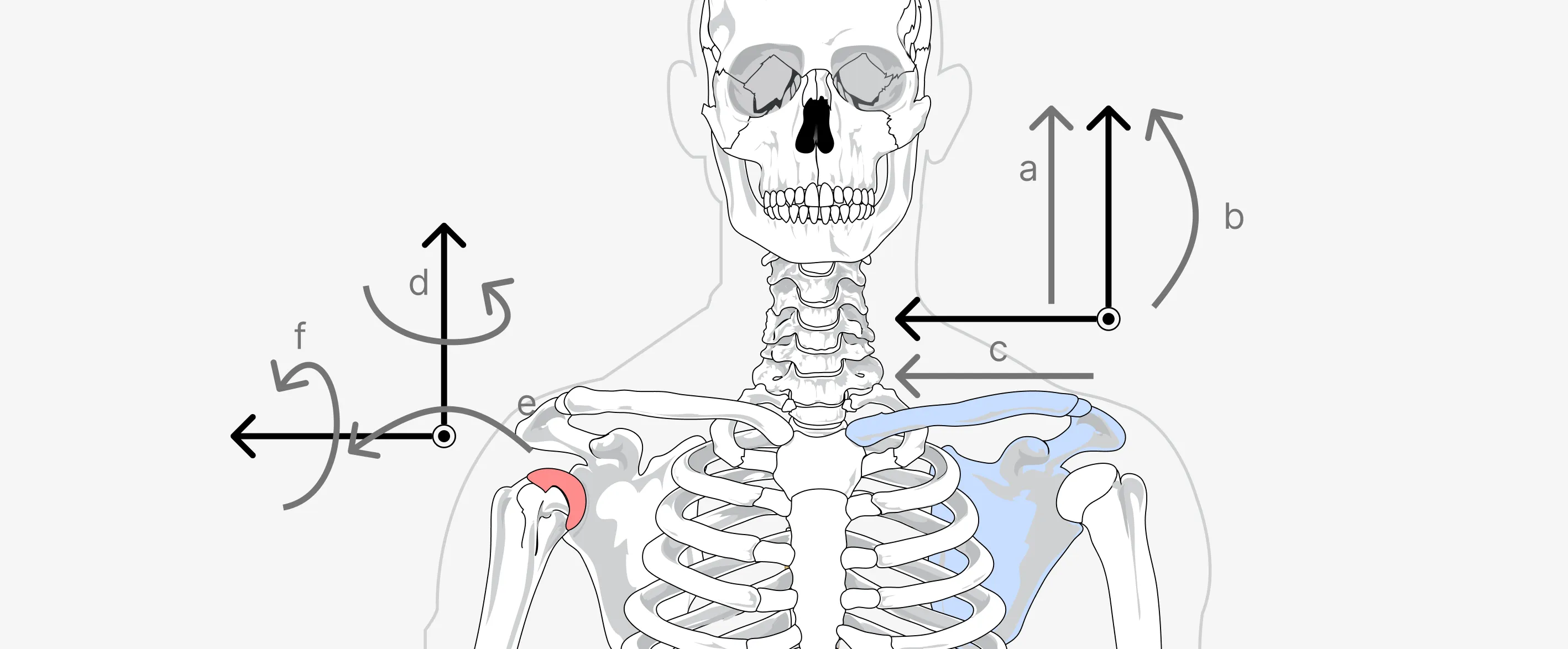
A degree-of-freedom atlas first places human and robot joints in shared, ISB-based coordinate systems. It specifies axes, signs, required degrees of freedom, and functional ranges of motion so that the biomechanics data and robot measurements use the same definitions.
From envelopes to a score
Human-Equivalence Envelopes then test whether a robot meets the human torque and power requirements simultaneously at the same joint angle and angular rate. Samples are weighted by positive human mechanical work, preventing performance in an irrelevant part of the workspace from compensating for failure in a task-relevant operating band. In the expression below, all torque and power terms in the indicator are evaluated at , and denotes positive human power; is the area element.
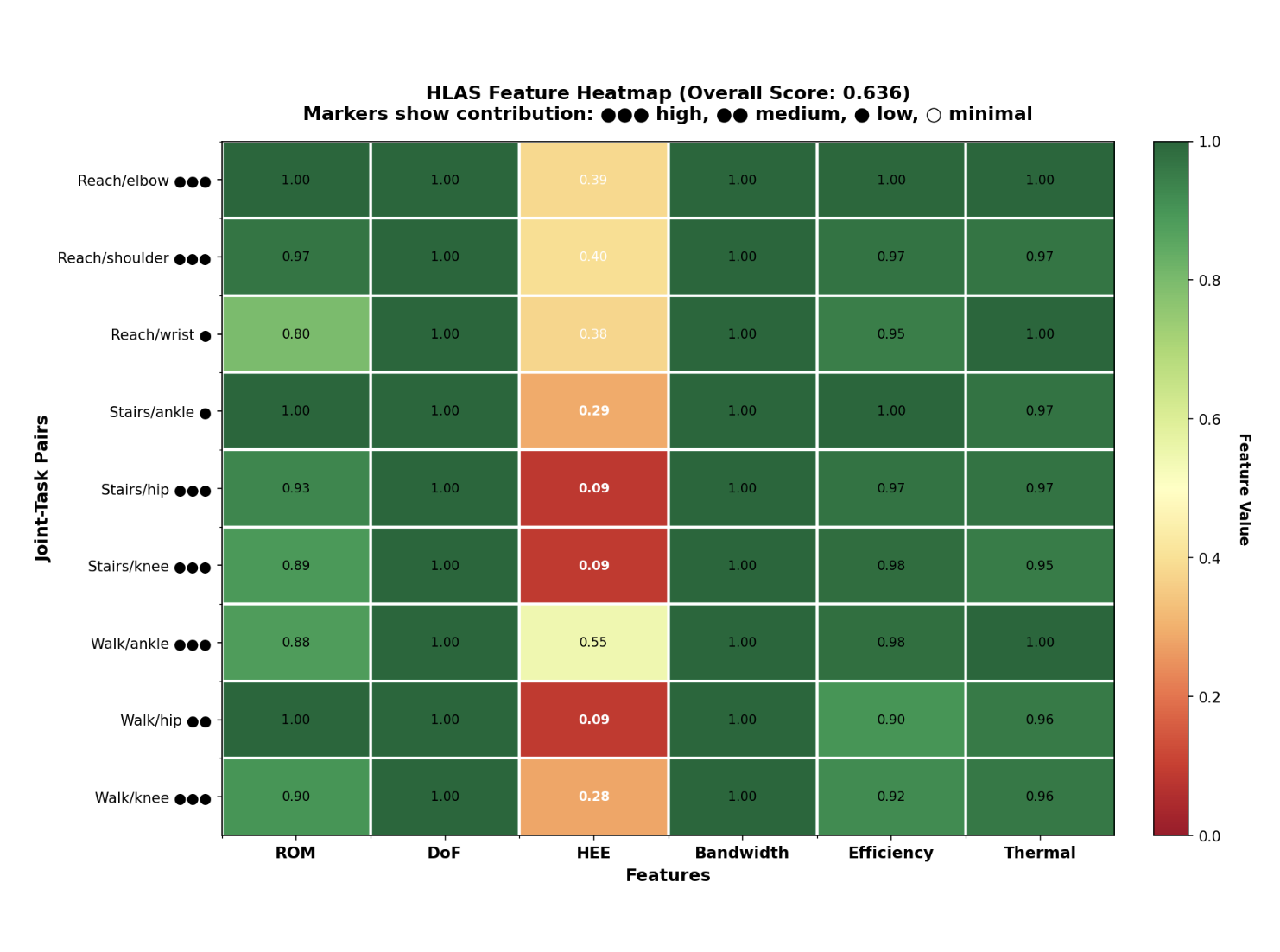
The Human-Level Actuation Score (HLAS) combines six normalized factors: range-of-motion coverage, required degrees of freedom, envelope coverage, torque-mode bandwidth, task-weighted efficiency, and thermal sustainability, collected in the feature vector . The scalar score is reported with its task-, joint-, and feature-level decomposition. The task weights , joint weights , and feature weights each sum to one.
Worked example
The paper demonstrates the calculation on a hypothetical 12-joint humanoid. Its data are synthetic but internally consistent; they are not measurements from a physical robot. Walking, stairs, and reaching receive task weights of 0.4, 0.3, and 0.3.
For ankle push-off during walking, the robot meets the human torque-power requirement at 8, 9, and 10 rad/s, but not at 11 or 12 rad/s, yielding a work-weighted envelope score of 0.546. The task scores are 0.671 for walking, 0.539 for stairs, and 0.687 for reaching. The overall HLAS is 0.636.
Scope
HLAS measures actuation, not whole-body capability. It does not directly score control, coordination, sensing, disturbance rejection, or task success. The human reference data vary across studies and populations, and the scalar depends on the selected tasks and weights. The current envelope emphasizes positive work rather than energy absorption or regeneration. The synthetic example and proposed protocols still require validation across physical robots and laboratories.