Imitation Learning with Human Eye Gaze via Multi-Objective Prediction
Interactive Learning with Implicit Human Feedback Workshop at ICML 2023 · Oral
Imitation learning usually records what a demonstrator does, but not what they look at. This paper introduces Gaze-Regularized Imitation Learning (GRIL), which predicts continuous flight controls and gaze coordinates from the same camera image. Gaze is an auxiliary training objective rather than a policy input, so deployment does not require an eye tracker.
The task is quadrotor navigation in Microsoft AirSim. A drone must find a yellow truck that begins outside its field of view, avoid obstacles, and navigate toward it. Evaluation covers both the demonstrated stationary-target task and a moving-target variant absent from the demonstration data.
For this work, I created the gaze-augmented demonstration dataset, designed the evaluation protocol, and ran the experiments.
Learning from where people look
GRIL receives a 224 × 224 RGB image. A pretrained MobileNet, fine-tuned on the demonstrations, produces a shared representation for two heads: four continuous flight controls and a two-dimensional gaze coordinate. The objective combines mean-squared gaze-prediction and behavioral-cloning losses. In the reported experiments, the gaze and action terms are weighted 0.1 and 0.9, respectively.
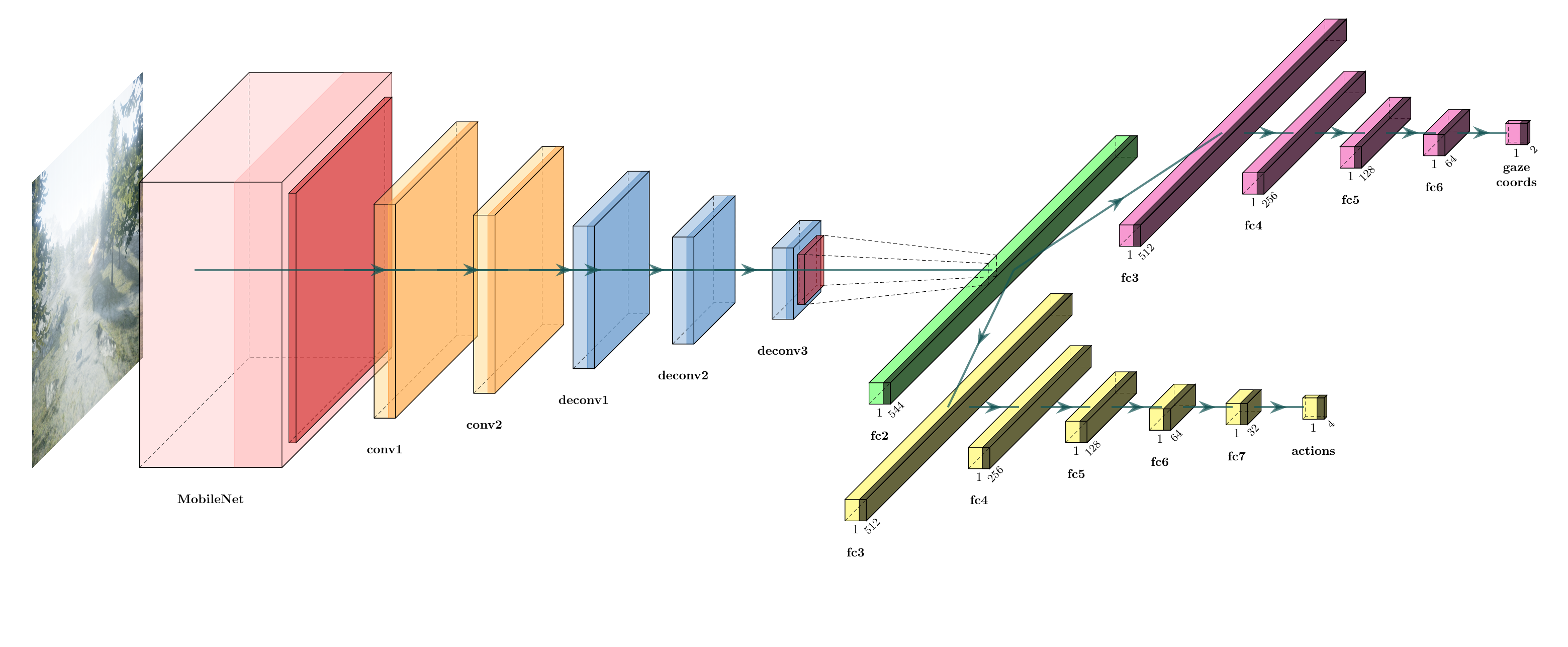
Flight experiment
The dataset contains 90 stationary-target trajectories recorded with an Xbox One controller and a screen-mounted eye tracker. Demonstrations cover 24 possible starts with randomized headings. Evaluation used 10 held-out starts and five rollouts from each, for 50 rollouts per model and task. Comparisons were behavior cloning (BC), an adapted Attention-Guided Imitation Learning model (AGIL), and BC with a context-aware gaze loss (BC-CGL).
GRIL had the highest completion rate and lowest collision rate in both reported tasks. Uncertainty below is standard error over the 10 evaluation start locations.
| Method | Completion | Collision |
|---|---|---|
| Stationary target | ||
| GRIL | 80 ± 9.9% | 20 ± 9.9% |
| BC-CGL | 64 ± 14.8% | 36 ± 14.8% |
| BC | 40 ± 13.7% | 58 ± 13.5% |
| AGIL | 10 ± 10.0% | 60 ± 16.3% |
| Moving target | ||
| GRIL | 40 ± 12.3% | 40 ± 9.4% |
| BC-CGL | 36 ± 14.8% | 42 ± 15.9% |
| BC | 30 ± 12.7% | 66 ± 12.3% |
| AGIL | 14 ± 10.3% | 86 ± 10.3% |
The moving-target policies were trained only on stationary-target demonstrations. The test therefore measures transfer within the same simulator and scene, rather than generalization to a new environment.
Scope
The experiments use one demonstrator and one simulated environment; they do not establish physical-flight performance or variation across people, eye trackers, and settings. The paper does not report learning curves across dataset sizes. Its AGIL and CGL comparisons are task-specific adaptations. GRIL could also lose the moving truck after it left the camera view, although it sometimes recovered when the target reappeared.